
Most executive coaching for leaders is an expensive way to achieve absolutely nothing. It is often a series of polite conversations that feel productive but leave the business exactly where it started. You have probably signed off on these programmes before. You see the invoices, you hear the positive feedback from the individual, yet the same leadership bottlenecks remain. It is frustrating. It is also a massive drain on budgets that should be driving growth.
I suspect you are sceptical because you have seen this play out too many times. I am going to explain exactly why traditional coaching fails and how to stop the rot. By anchoring every conversation in objective behavioural data and a “Level 0” capability starting point, you can turn a vague personal development exercise into a rigorous commercial tool. we will look at how to measure what actually matters so your leaders become more adaptable and your strategy finally sticks.
Key Takeaways
- Identify why most coaching is an expensive series of aimless chats that fail to produce measurable behavioural changes.
- Effective executive coaching for leaders requires objective profiling data to remove the guesswork from personal development.
- Use triple-state mapping to bridge the gap between where a leader is now and where the business needs them to be.
- Establishing a Level 0 starting capability is the only honest way to measure the commercial return on your coaching spend.
The Failure of Vibe-Based Executive Coaching
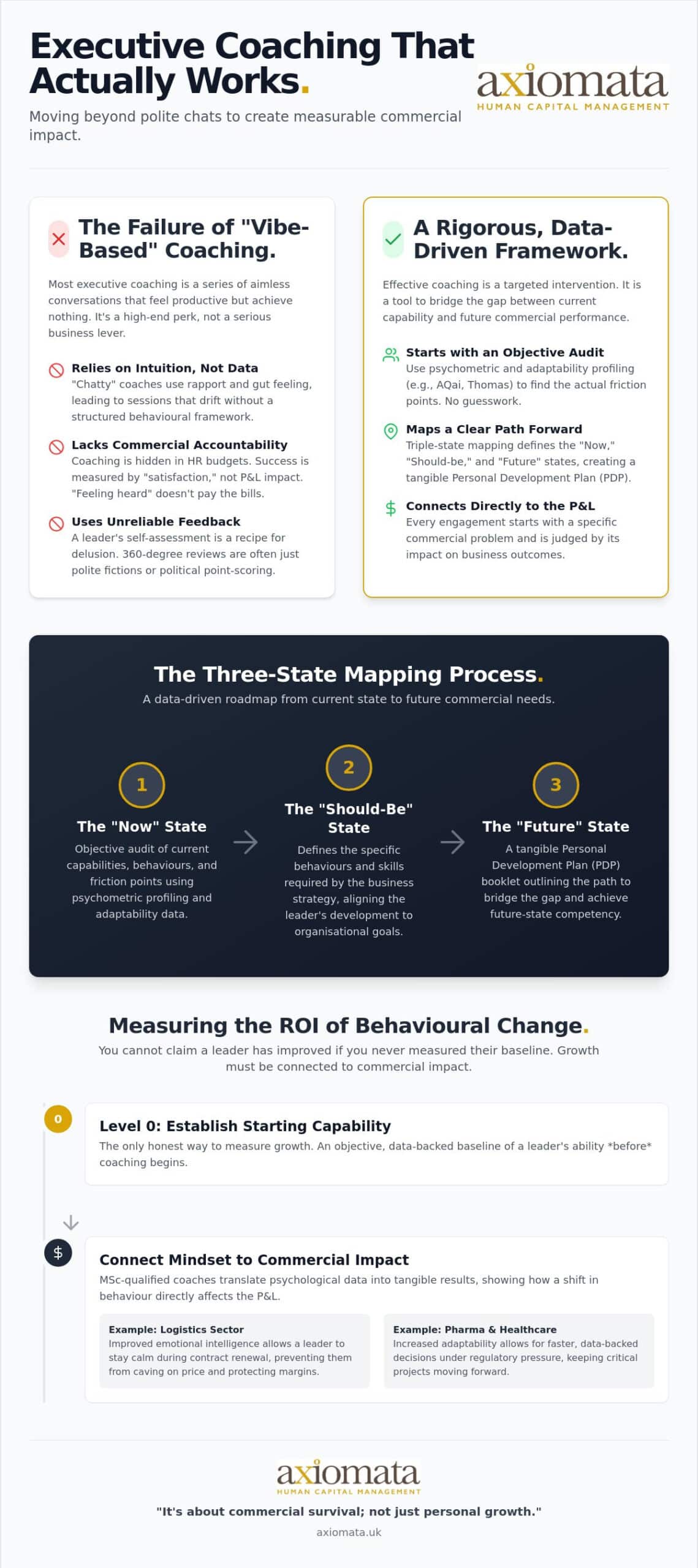
I have seen enough HR budgets burned on executive coaching to know that it’s often treated as a high-end perk rather than a serious business lever. It is the corporate equivalent of a spa day. A leader feels “heard,” they enjoy a bit of reflection, and the coach gets a nice retainer. But for a logistics firm managing tight margins or a pharma giant facing a patent cliff, “feeling heard” does not pay the bills. If the coaching doesn’t result in a measurable shift in how a leader handles a crisis or manages a team, it is a waste of money.
The problem is the “chatty” coach. These are people who rely on rapport and intuition rather than a structured behavioural framework. They have great vibes but no data. Without a clear map of what a leader actually does versus what they should do, these sessions just drift. Real executive coaching for leaders should be a targeted intervention. It is a tool to bridge the gap between current capability and the future commercial performance the board expects. If you can’t define the gap, you shouldn’t be paying for the coach.
Why Subjective Feedback is Not Enough
Relying on a leader’s self-assessment is a recipe for delusion. Most of us are terrible at judging our own impact. Even 360-degree reviews are often just a collection of polite fictions or political point-scoring. They rarely capture the underlying behavioural drivers that actually dictate performance. You need something more objective than a “gut feeling” from a coach who has only known the leader for six weeks. Without profiling, you’re just guessing.
The Commercial Accountability Gap
Coaching belongs on the P&L, not hidden in an HR slush fund. Every engagement should start by identifying a specific commercial problem. Perhaps it is a failure to integrate an acquisition or a sales team that cannot articulate value. If you want to see what executive coaching and mentoring looks like when it’s actually tied to results, you have to stop measuring “satisfaction” and start measuring output. It’s about commercial survival; not just personal growth.
Anchoring Leadership Growth in Objective Data
If a coach sits down with a leader and asks “what do you want to talk about today,” you have already lost. That is a social call. Effective executive coaching for leaders must start with a profile; not a blank page. We use triple-state mapping to define the “Now,” the “Should-be,” and the “Future.” It is about establishing a data-driven coaching programme that moves beyond anecdotes. You need to know exactly what is happening in the leader’s head before you try to change what they do on the shop floor.
This is where psychometric profiling becomes essential. It provides the literal bones of the conversation. It stops the leader from hiding behind corporate platitudes. When we combine this with an adaptability assessment, we see how they actually respond when the market shifts or a supply chain breaks. In volatile sectors like logistics or pharma, being “nice” is less important than being able to pivot under pressure. If you are curious about how your own team stacks up, you can explore our diagnostic approach.
The Pre-Coaching Audit
We use instruments like AQai and Thomas to find the actual friction points. Most leaders don’t need to learn more things. They need to unlearn the habits that got them to the middle but are stopping them from reaching the top. If a Director is still micromanaging because they are high in “Control” but low in “Trust” on a profile, that is the conversation. We don’t guess. We audit.
Creating the Personal Development Plan (PDP) Booklet
A tangible roadmap is better than a vague promise of growth. We turn the data into a PDP booklet that aligns with your organisational competency matrix. It is not an abstract exercise. It is a data-backed document that tracks progress against real business needs. If it doesn’t help the leader make better decisions, it doesn’t go in the book.
Measuring the ROI of Behavioural Change
Most firms measure coaching by asking the leader if they enjoyed the sessions. That is Level 1 of the Kirkpatrick model. It is also useless. We use a six-step ROI chain that begins at Level 0, which we define as the Starting Capability. You cannot claim a leader has improved their negotiation skills if you never measured their baseline ability to hold a margin under pressure. Without that initial anchor, any talk of “growth” is just a guess.
Connecting mindset shifts to deal performance requires a specific level of expertise. This is why we use MSc-qualified coaches. You need someone who can translate complex psychological data into commercial results. It is not enough to talk about “leadership style.” You have to show how a shift in that style directly affects the P&L. If your coach cannot explain the link between a leader’s psychometric profile and their strategic impact, they are probably just a very expensive sounding board.
From Mindset to Commercial Impact
In the logistics sector, improved emotional intelligence is not about being “nicer.” It is a tactical advantage. It is about a leader staying calm during a high-stakes contract renewal so they don’t cave on price at the first sign of friction. Similarly, in healthcare or pharma, adaptability is the difference between a project stalling or moving forward. When a leader can make faster, data-backed decisions under the pressure of changing regulations, the commercial uplift is immediate and obvious.
The Final Goal: Lasting Behavioural Change
Coaching ends when the new behaviour becomes the default, not when the sessions run out. Usage metrics are for SaaS platforms; they have no place in serious executive coaching for leaders. We don’t care how many hours were logged or how many cups of coffee were consumed. Axiomata’s approach prioritises commercial outcomes over everything else. If the leader still needs the coach to help them make a difficult decision after six months, the intervention has failed. The goal is an independent, commercially effective leader who no longer needs the support.
Stop Paying for Conversations and Start Investing in Capability
If you’re still treating coaching as a professional social club, you’re lighting money on fire. Real executive coaching for leaders isn’t about feeling better; it’s about being better at the job. We’ve seen this work. One of our logistics clients saw a 29.7% growth in order intake because their leaders stopped guessing and started using behavioural data. Our MSc-qualified coaches don’t do “vibes.” We use accredited partnerships with AQai and Thomas. We also integrate EBW profiling to ensure every conversation is anchored in reality.
You can enquire about bespoke executive coaching and mentoring to see how this diagnostic approach fits your own strategy. It’s a hard shift to make. Once you anchor development in data, the commercial clarity is worth the effort. Let’s get to work.
Frequently Asked Questions
Is executive coaching worth the investment for mid-level leaders?
It is worth the investment if you treat it as a strategic intervention rather than a reward for tenure. Mid-level leaders are often the ones closest to the actual friction points in logistics or healthcare operations. If they can’t delegate or handle conflict, the entire operation slows down. Coaching at this level helps prevent the behavioural bottlenecks that eventually stall senior-level strategy. If you don’t fix these habits early, you’ll just pay more to fix them later.
Can executive coaching be measured with hard ROI metrics?
You can measure it, but you have to stop using “satisfaction” as a metric. We look at commercial outputs like deal velocity or order intake growth. By establishing a Level 0 baseline of capability before the programme starts, you can track exactly how the shift in behaviour impacts the bottom line. If you can’t see the change in your P&L, the coaching hasn’t worked. It is that simple.
How much does a bespoke executive coaching programme typically cost?
Fees for executive coaching for leaders vary based on the coach’s experience and the seniority of the individual being coached. Instead of looking at the hourly rate, you should look at the value at risk. A CEO making a single bad decision because of a behavioural blind spot costs far more than any six-month programme. We focus on the commercial return rather than competing on the lowest day rate.
What is the difference between executive coaching and leadership mentoring?
Coaching is about the process of behavioural change, usually led by experts who understand the psychology of performance. It is about how a leader thinks and acts. Mentoring is about specific industry experience; it is someone saying “I have run a pharma firm, here is how I did it.” You often need both, but they serve different functions. One fixes the person’s approach; the other provides the map.

Disclaimer
The opinions expressed are entirely my own and were formed after years of working in Sales. Any resemblance to sanity is purely coincidental.

