
Most B2B sales training fails because it prioritises scripts over strategic thinking. It’s a tired approach that ignores why clients actually buy. They buy value. You likely recognise the frustration of watching capable people lose deals to low-cost competitors whilst failing to use the AI tools you have provided. It’s a common symptom of a sales force that has stopped thinking and started reacting. If your team can’t articulate value beyond a price list, they are essentially redundant.
This article outlines how to pivot your force toward value-based methodologies that justify premium pricing and turn transactional vendors into genuine strategic partners. You will see how to combine high Adaptability Quotient (AQ) with narratives that no software can replicate. We will look at the specific shift from selling features to delivering measurable business outcomes through cultural transformation and better psychometric alignment. This requires a fundamental change in how your team perceives their role in the client’s business. The goal is moving from a vendor mindset to a consultative one.
Key Takeaways
- Stop treating sales training as a box-ticking exercise. Start building a team that prioritises strategic adaptability over memorised scripts.
- Move beyond the traditional funnel by adopting value-based methodologies that justify your margins against low-cost competitors.
- Delegate data management to AI whilst training your people to master the nuance and trust that software cannot replicate.
- Focus on behavioural change as a leading indicator of success. Revenue figures only tell you what has already happened.
- Align individual psychometric profiles with commercial goals. It ensures your culture transformation actually sticks.
Beyond the Basics: Why Modern Sales Training is Non-Negotiable in 2026
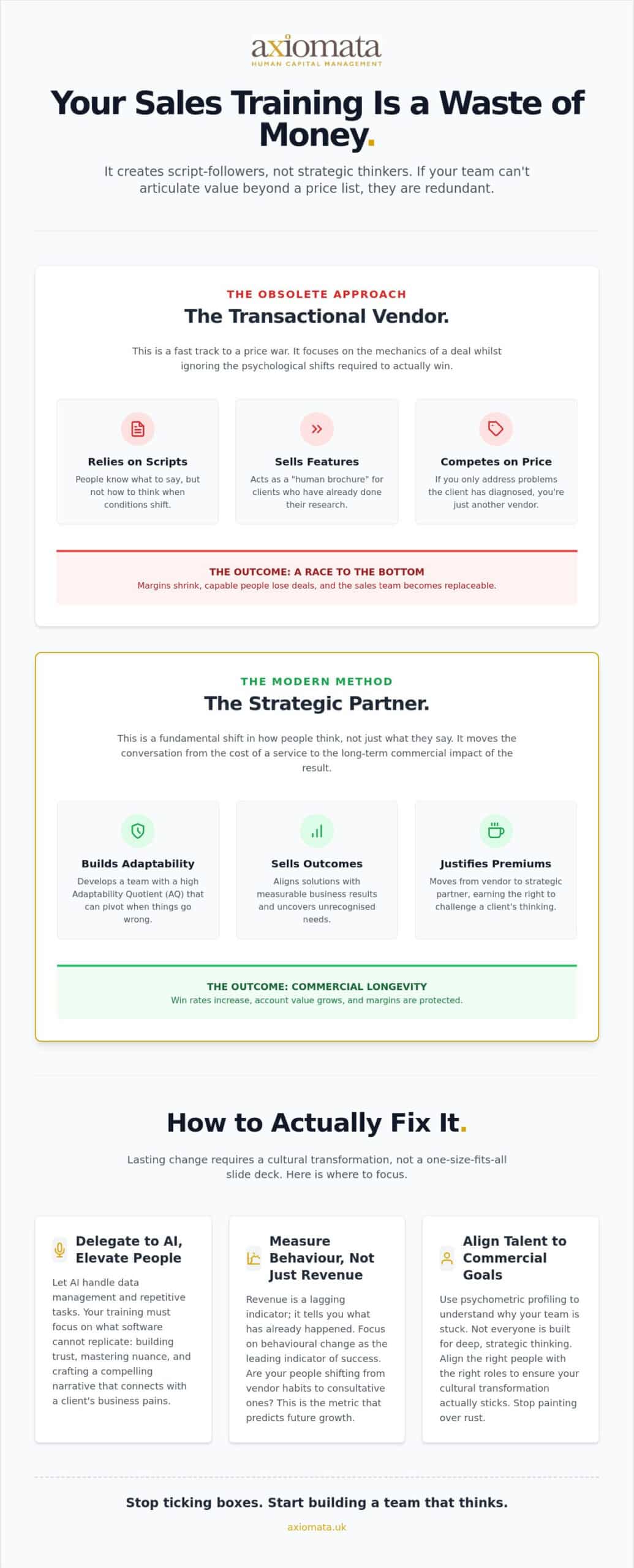
Traditional sales training is often a performance in futility. It focuses on the mechanics of the deal whilst ignoring the psychological shifts required to actually win. In a market where your competitors are a click away, “feature-dumping” is a fast track to a price war. Buyers in logistics or healthcare already have the data. They don’t need a human brochure. Modern training must be a holistic development of mindset and adaptability. It’s about closing the Adaptability Gap that leaves teams stranded when conditions shift.
The objective is to increase win rates and grow account value. We also need to ensure commercial longevity. If your team cannot articulate value beyond the product itself, they are essentially redundant. We are looking for a fundamental shift in how people think, not just what they say. Most teams know what to do when things go right. Very few know how to pivot when they don’t.
The Shift from Transactional to Strategic Selling
The “order-taker” is a dying breed. Buyers in healthcare and pharma now value insights over information. They have already researched the foundational sales principles and your product’s technical specs before you even pick up the phone. Shifting to a strategic consultant approach requires deep behavioural change. This is where executive coaching becomes necessary. It isn’t about learning a new trick. It’s about unlearning the habit of being a vendor.
Why “Off-the-Shelf” Programmes Often Fail
Generic courses are a box-ticking exercise for the uninspired. They lack the customisation required to address your specific market pressures. If the training doesn’t align with your organisational objectives, the team will revert to old habits within a fortnight. Lasting change requires a cultural transformation. You cannot fix a performance problem with a one-size-fits-all slide deck. You need to look at the psychometric profiling of your team to understand why they are stuck in the first place. Without that, you’re just painting over rust.
The Evolution of Methodology: From Transactional Selling to Value Creation
The traditional sales funnel is a relic. It assumes a linear progression that rarely exists in complex B2B environments. Modern sales training focuses on value creation. Moving leads through a pipe is no longer enough. This requires identifying unrecognised needs. These are the underlying business risks or missed opportunities that your client hasn’t yet spotted. If you only address the problems they’ve already diagnosed, you’re competing on price. You’re a vendor. You are not a partner.
Building a team capable of this shift requires more than a weekend workshop. It requires psychometric profiling to ensure you have the right cognitive diversity. Not everyone is naturally inclined toward the deep, strategic thinking required for high-value accounts. Some prefer the quick win. You need both, but you must know who is who. It’s about aligning talent with the specific commercial objectives of your business.
Mastering the Value-Based Narrative
Value-based selling is the alignment of solutions with strategic business outcomes. To achieve this, you must sell the problem before you ever mention the solution. If a stakeholder doesn’t feel the cost of their current inefficiency, your proposal is just an expense. This is one of the most effective sales training techniques for protecting margins. Move the conversation from the cost of the service to the long-term commercial impact of the result.
Consultative Techniques for High-Value Accounts
Managing complex stakeholder environments in logistics or healthcare requires more than just a firm handshake. It requires executive presence and active listening. You have to hear what isn’t being said in the boardroom. This level of sophistication is often missing in standard L&D programmes. Engaging in Executive Coaching for Leaders can help your senior sellers develop the gravitas needed to challenge a client’s thinking. If you want to see how this works in practice, you might consider an adaptability assessment for your current leadership team through Axiomata.
The AI Frontier: Integrating Technology with Human Adaptability
AI is frequently used to scale mediocrity. It’s a tool for making bad habits happen faster. This is a waste of capital. In our Value Selling in the AI Era programme, we argue that AI should manage the data whilst humans manage the nuance. The machine finds the pattern. The person finds the meaning. This synergy is what defines effective sales training in a saturated market. If your team can’t interpret AI-driven insights with empathy, they’re essentially just a slower version of the software.
The Role of AQ (Adaptability Quotient) in Sales
Adaptability Quotient (AQ) is a better predictor of success than IQ or EQ in volatile sectors like pharma or logistics. It measures how quickly a person can unlearn old habits. Most sales teams are stuck in the past. They lack the cognitive flexibility to pivot when a buyer’s strategy changes overnight. We use an AQ adaptability assessment to benchmark this. You can’t train for adaptability if you don’t know your starting point. It’s about resilience under pressure. Success depends on the ability to change course without losing momentum.
Using AI Without Losing the Human Touch
Automation is a race to the bottom. It’s cheap and it looks like noise to a senior decision-maker. Use AI for the heavy lifting of prospecting and data analysis. This frees up time for the human-centric work that actually closes deals. Authenticity can’t be automated. When every competitor is sending AI-generated drivel, a thoughtful, human-led narrative stands out amongst the noise. You need to be real. Don’t let the machine speak for you when the stakes are high.
Measuring Impact: How to Ensure Your Sales Training Delivers Real ROI
Revenue figures are a distraction. They are lagging indicators that tell you what happened months ago. You cannot manage a result; you can only manage the behaviours that lead to it. Effective sales training must be measured by leading indicators. This means tracking how your team’s approach shifts in real-time. If you aren’t seeing a change in the quality of the conversation, the investment is wasted.
We use a five-step process to ensure effectiveness. First, establish a baseline through assessment centres. Second, define the specific behavioural shifts required. Third, monitor the application of new techniques in live deals. Fourth, measure the impact on deal margins. Finally, review long-term cultural alignment. This structured approach prevents the sugar high of a one-off workshop that fades within a month. Our sales training methodologies incorporate these centres to provide the data needed to justify the spend. It moves the conversation from whether they liked the trainer to whether they can actually do the job.
Identifying Key Performance Indicators (KPIs)
Stop obsessing over raw volume. Look at deal margins instead. A team that handles price objections without immediately discounting is a team that has internalised value-based selling. You should also track the length of the sales cycle. If your sellers are acting as strategic consultants, they should be reaching decision-makers faster. This reduces the friction that kills most B2B deals. It’s about quality of engagement over quantity of activity.
The Importance of Ongoing Coaching and Mentoring
Change is difficult. It’s also easy to ignore when the pressure is on. This is why a single workshop is never enough. You need executive mentoring to sustain the momentum. It provides the accountability that internal managers often lack. In cases of transition, interim management can bridge the gap. It ensures that new behaviours become the standard rather than a temporary experiment. If you want to see real results, you must commit to the long-term development of your leaders. Before you invest, it is worth understanding why executive coaching for leaders so often fails to deliver commercial results and what separates a rigorous intervention from an expensive conversation.
Partnering for Success: The Axiomata Approach to Sales Excellence
Most providers sell a product. We sell an intervention. Axiomata operates on the principle that people potential is the only sustainable driver of business growth. We don’t do “off-the-shelf” programmes. They are lazy. Instead, we use psychometric profiling and AQ assessments to understand the raw material we are working with. This ensures the sales training actually aligns with the human beings expected to deliver it. It’s about finding the root cause of underperformance rather than treating the symptoms.
Bespoke Interventions for Lasting Change
We build assessment centres to mirror the specific pressures of your market. These are diagnostics, not generic simulations. We integrate our Value Selling in the AI Era framework directly into your existing culture. It’s a surgical approach. We also provide executive coaching to support the leaders who must keep the new standards alive. If the leadership doesn’t change, the team won’t either. It’s that simple.
Next Steps for Your Organisation
Cultural transformation starts with a diagnostic. We don’t guess. We assess the current state of your talent before proposing a path forward. This ensures that every hour spent in training is an hour spent solving a verified problem. If you are ready to move beyond the superficial and align your talent development with your commercial objectives, we should talk. You can enquire about bespoke sales training to begin the process. We prefer to work with leaders who are as impatient for results as we are.
Securing Commercial Longevity through Strategic Alignment
The gap between a transactional vendor and a strategic partner is wider than most leaders realise. If your team continues to compete on price, they are already losing. Modern sales training must move beyond scripts to address the fundamental adaptability of your people. You need a team that can interpret AI-driven data whilst maintaining the human nuance that actually builds trust in healthcare and logistics. This is a commercial necessity rather than a soft skill.
Success depends on how well you align individual potential with your business goals. Our specialised Value Selling in the AI Era programme and bespoke AQ adaptability assessments provide the diagnostic clarity needed to transform your culture. We combine this with expert executive coaching and mentoring to ensure performance improvements actually stick. Your team is capable of more than just hitting targets. They can drive the strategy.
Realise your sales team’s potential with Axiomata’s bespoke training
Frequently Asked Questions
What is the difference between traditional sales training and value selling?
Traditional training focuses on the seller’s process and product features. Value selling focuses on the buyer’s commercial outcomes. It requires moving from being a vendor of products to a consultant who identifies unrecognised business risks that the client hasn’t yet diagnosed.
How does AI impact the effectiveness of B2B sales training?
AI handles the data-heavy aspects of the role. Modern sales training must focus on the nuance that software cannot mimic. This includes empathy, strategic interpretation, and the ability to challenge a client’s thinking during complex negotiations in sectors like healthcare or pharma.
Why is Adaptability Quotient (AQ) important for sales teams?
AQ measures how quickly a person can unlearn old habits and adopt new strategies. In volatile markets like logistics, a high AQ is a better predictor of success than years of experience. It ensures your team can pivot when a client’s strategy changes without warning.
How long does it take to see a return on investment from sales coaching?
Behavioural shifts are usually visible within weeks. You will see better price objection handling and more strategic conversations almost immediately. Revenue is a lagging indicator. It will follow according to your specific deal cycle and current market conditions.
Can sales training help with handling complex price objections?
Yes, by teaching sellers to sell the problem before the solution. If the client understands the true cost of their current inefficiency, your price becomes a secondary concern. It moves the discussion from an expense to a commercial investment in their business.
What role does psychometric profiling play in sales team development?
Profiling identifies whether a person has the cognitive traits for strategic consulting. It prevents the mistake of putting a transactional seller into a complex account. It aligns individual potential with your organisational objectives to ensure the right people are in the right roles.
How do you ensure sales training leads to long-term culture transformation?
Transformation requires executive mentoring and ongoing accountability. One-off workshops fail because they lack the follow-up required to make new behaviours stick. Leadership must be actively involved in reinforcing the new standards until they become part of the culture.
What makes Axiomata’s sales training different from other providers?
We provide bespoke interventions based on diagnostic data. We use assessment centres, psychometric profiling, and our specialised Value Selling in the AI Era programme to address the root causes of underperformance. We don’t sell standardised, off-the-shelf sales training.

Disclaimer
The opinions expressed are entirely my own and were formed after years of working in Sales. Any resemblance to sanity is purely coincidental.

