
Redefining Sales Prospecting in the AI-Driven Marketplace
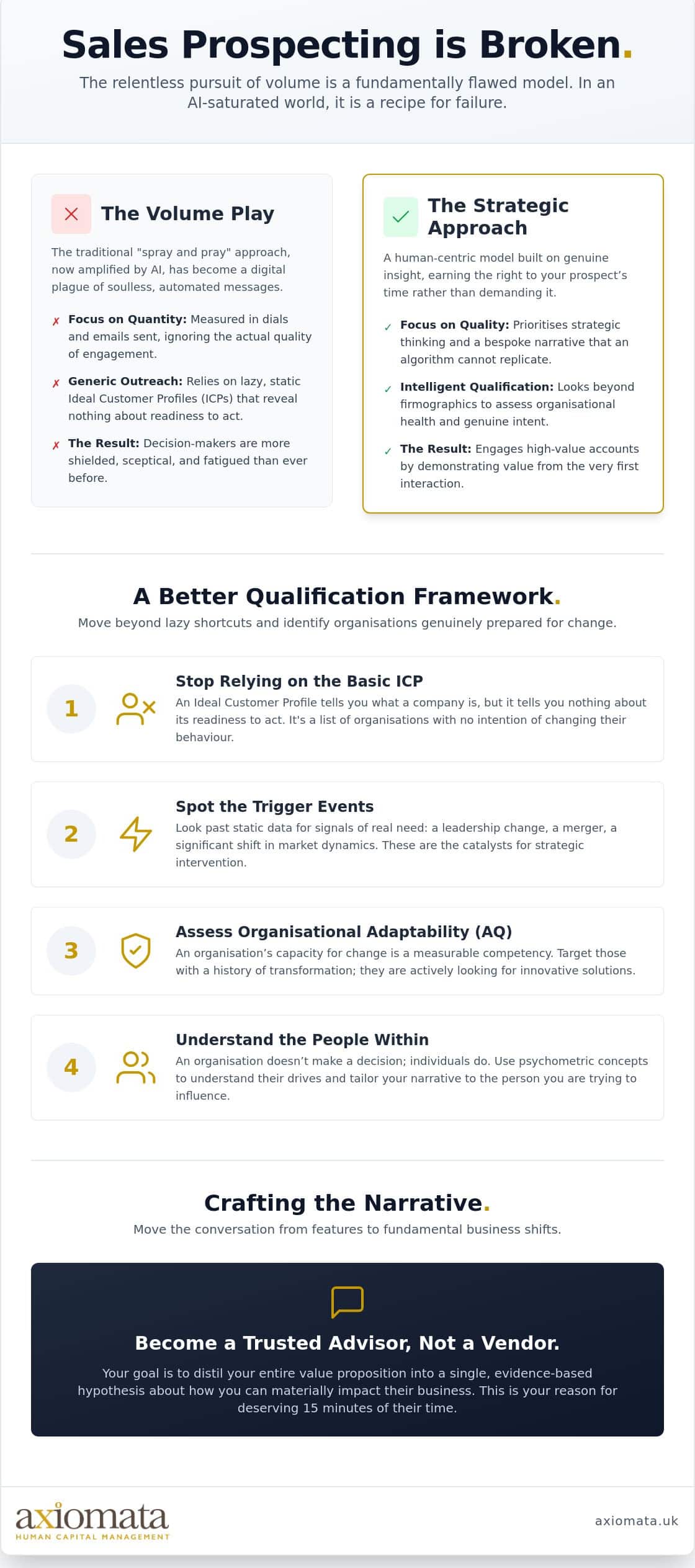
Most sales prospecting is a complete waste of time. Not because sales professionals are lazy, but because the model they are forced to use is fundamentally broken. The relentless pursuit of volume, measured in dials and emails sent, has created an environment so saturated with noise that any meaningful signal is lost.
Traditional “spray and pray” was always inefficient. Now, with every account executive armed with an AI writing assistant, it has become a digital plague. Our prospects’ inboxes are filled with an endless stream of perfectly structured, grammatically flawless, and utterly soulless messages. The result is that decision-makers are more shielded, more sceptical, and more fatigued than ever before.
In this environment, clinging to quantity over quality is a recipe for failure. High-value B2B sales cycles are not transactional. They are complex, political, and intensely human. They require trust, insight, and a genuine point of view. This is where the concept of Value Selling becomes less of a training-day buzzword and more of a basic survival strategy. It is the practice of demonstrating your value from the very first interaction, earning the right to your prospect’s time rather than simply demanding it.
The Impact of AI on Buyer Behaviour
The rise of generative AI has not made prospecting easier; it has simply made it louder. Decision-makers now operate under the correct assumption that the vast majority of unsolicited outreach is automated, generic, and requires zero intellectual effort from the sender. This has trained them to ignore anything that does not immediately resonate with a specific, pressing business problem.
Your challenge is not to create a slightly better automated message. It is to create a human-centric, bespoke narrative that an algorithm cannot replicate. This requires genuine research, strategic thinking, and the confidence to present a point of view that challenges the prospect’s thinking. It requires you to sound like a person who has earned their opinion.
Why High-Value Accounts Require a Different Lens
Prospecting for a complex, high-value account is a different discipline from transactional selling. You are not trying to find one person who can sign a purchase order. You are engaging with a complex web of stakeholders, each with their own agenda, priorities, and political capital. A single champion is no longer enough.
Success requires multi-threaded engagement across the decision-making centre. This means your initial outreach—your “Value Narrative”—must be sophisticated enough to resonate with a CFO, a Head of Operations, and a Chief Technology Officer simultaneously. It must address the fundamental business shift, not just the surface-level symptoms. This is the core of strategic, account-based prospecting.
Identifying High-Value Opportunities: Beyond the Basic ICP
The Ideal Customer Profile (ICP) is often treated as a sacred text. In reality, it is a lazy shortcut. Relying on firmographics like sector, revenue, and employee count tells you what a company is, but it tells you nothing about its readiness to act. You end up with a perfectly qualified list of organisations that have absolutely no intention of changing their behaviour.
The most important qualification criterion is not a company’s size, but its organisational health and willingness to evolve. You must look past the static data and learn to spot the trigger events—a leadership change, a merger, a shift in market dynamics—that signal a genuine need for strategic intervention. It is about aligning your solution not just with their business model, but with their current trajectory.
Leveraging AQ to Target Resilient Organisations
An organisation’s capacity for change is not a vague cultural attribute; it is a measurable competency. This is where the concept of the Adaptability Quotient (AQ) becomes a critical tool in sales prospecting. Organisations with high adaptability are not just more likely to survive disruption; they are actively looking for innovative solutions to stay ahead. They are, by definition, better prospects.
Before you reach out, research a target’s history of transformation. Have they successfully integrated acquisitions? Have they pivoted their business model in the past? This insight allows you to use adaptability as a primary qualification filter, focusing your finite resources on accounts that are culturally and structurally prepared to engage in a meaningful conversation about change.
The Power of Psychometric Insights in Lead Qualification
Once you have identified an adaptable organisation, you must still navigate the people within it. An organisation does not make a decision; a group of individuals does. Understanding their behavioural drives and communication styles is the final layer of intelligent qualification.
Using psychometric profiling concepts helps you categorise potential stakeholders. Who is the natural champion for a new idea? Who is the risk-averse guardian of the status quo? Who is the data-driven analyst that needs to be convinced with logic? These insights allow you to prioritise outreach and tailor your narrative to the specific personality you are trying to influence, dramatically increasing the probability of a positive response.
The Psychology of Outreach: Tailoring Your Narrative for Impact
Consider for a moment the emotional state of a senior leader receiving your cold email. They are time-poor, responsible for hundreds or thousands of people, and their inbox is a battlefield of competing priorities. They are not looking for another vendor. They are looking for clarity, confidence, and solutions to problems that keep them awake at night.
Engaging at this level requires what we call “Strategic Confidence.” It is the ability to move the conversation away from features and functions and towards fundamental business shifts. It is the difference between saying “Our software does X” and “I’ve seen how businesses like yours are struggling with Y, and it’s often because they are missing the connection between Z and A.” One is a sales pitch; the other is a strategic insight.
Crafting the Value-Based Narrative
A powerful value narrative is built on principles of Value Selling in the AI Era. It must establish credibility immediately by demonstrating a deep understanding of the prospect’s world. The structure should address the root cause of their likely problem, not just the surface symptom they might be talking about publicly.
Your goal should be to distil your entire value proposition into a single, powerful sentence that focuses on an enduring result. This is not a marketing tagline. It is a concise, evidence-based hypothesis about how you can materially impact their business. It is your reason for deserving 15 minutes of their time.
Executive Mentoring and the Sales Professional
The most effective sales professionals in high-value environments do not act like vendors. They position themselves as trusted advisors or mentors who can offer a valuable external perspective. This is not a trick; it is a fundamental shift in mindset.
Developing this kind of gravitas is not easy. It often requires executive-level coaching to help sales leaders refine their communication style, think more strategically, and maintain a professional, aspirational tone that is grounded in commercial reality. It is about becoming the kind of person a CEO wants to talk to.
A Method for High-Value Sales Prospecting
This is not a checklist. It is a methodical, direct, and highly organised way of thinking about a sales prospecting campaign. It integrates data, psychology, and strategic outreach into a cohesive flow designed for high-value B2B accounts.
- Step 1: Deep Diagnostic Research
Conduct a fundamental analysis of the target organisation. Go beyond their website and press releases. What is the core strategic challenge they face over the next 18 months? Identify the three key concepts that align your solution with their long-term goals. Map the decision-making centre and form a clear hypothesis about the key influencers and their likely motivations.
- Step 2: Multichannel Value Engagement
Organise a tiered outreach strategy that is patient and purposeful. Use social channels to understand their public conversation, email for direct and concise propositions, and prepare for executive-level engagement. Every single touchpoint must deliver a unique insight. Do not send messages “just to check in.” Use an active voice and declarative statements to establish authority and clarity from the very first word.
Elevating Your Sales Performance with Axiomata Business Solutions
We work with organisations that have recognised the old models of sales and leadership are no longer fit for purpose. They are seeking a fundamental evolution in how their teams perform, and we provide the strategic interventions to make that happen.
Our approach to sales training transforms team behaviour by embedding the principles of value, adaptability, and psychological insight into every customer interaction. We use executive coaching to refine leadership, and our psychometric and AQ assessments provide the data needed to build resilient, high-performing teams.
Tailored Sales Training for Modern Teams
Our bespoke programmes are designed to align your talent development directly with your most important commercial objectives. We help teams move beyond outdated scripts and processes, equipping them with the strategic thinking required to win complex, high-value accounts. This is not a one-off workshop; it is a catalyst for lasting organisational change.
If the challenge of building a more strategic, effective sales prospecting function resonates with you, then we should talk.
Enquire about our bespoke Sales Training and Coaching Programmes

Article by
Martyn Poller
Dad. Coach. Value selling nerd. Festival enthusiast. Writes SEO content that people actually want to read. Firm believer that if Google likes it too, that’s just a bonus. Drinks too much tea, overthinks headlines, and has an unhealthy relationship with continuous learning!
Disclaimer
The opinions expressed are entirely my own and were formed after years of working in Sales. Any resemblance to sanity is purely coincidental.

